
If you’ve ever searched how hard is nursing school, you’re definitely not alone. It’s one of the most common questions aspiring healthcare professionals ask before taking the leap. Nursing school has a reputation for being intense, demanding, and life-changing—but what does that actually mean in real terms?
In this article, we’ll break down how hard is nursing school, what makes it challenging, especially at a community college, and even answer on a scale of 1 to 10 how hard is nursing school. We’ll also connect it with something just as important: the personal life values that help students survive and succeed.
Understanding How Hard Is Nursing School?
When people ask how hard is nursing school?, they’re usually trying to understand the workload, stress level, and emotional pressure involved.
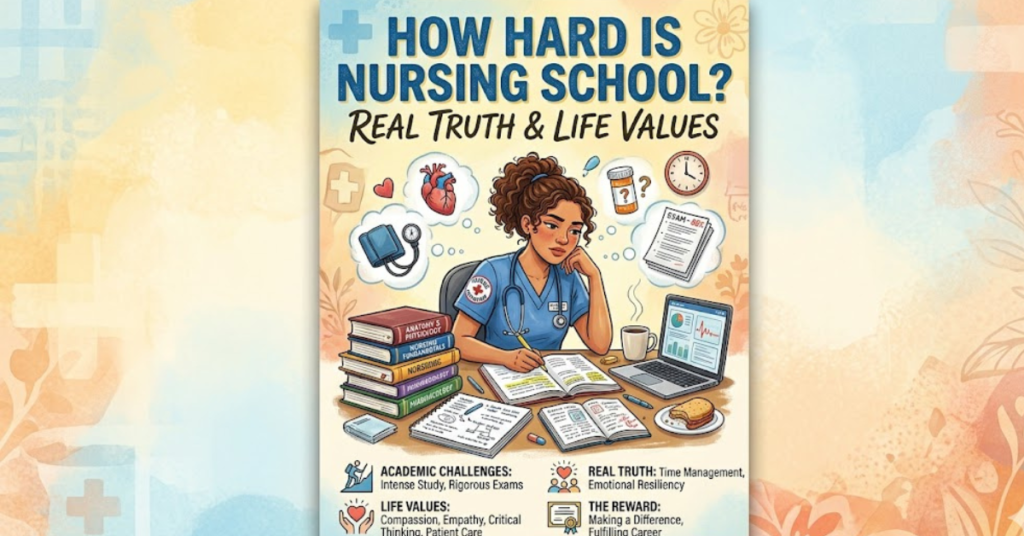
Nursing school is hard because it combines:
- Heavy science-based coursework (anatomy, pharmacology, microbiology)
- Clinical rotations in real healthcare settings
- High-stakes exams and practical skills testing
- Emotional exposure to patient care and critical situations
It’s not just about memorizing facts—it’s about learning how to think and act like a nurse under pressure.
On a Scale of 1 to 10 How Hard Is Nursing School?
If we had to rate it honestly, on a scale of 1 to 10 how hard is nursing school, most students and graduates would place it around:
8 to 10 out of 10
Why so high?
- Fast-paced learning with very little downtime
- Exams that require critical thinking, not just memorization
- Constant balancing of school, study, and clinical hours
- Emotional stress from patient care experiences
However, difficulty can feel different depending on your study habits, discipline, and support system.
How Hard Is Nursing School at a Community College?
Many students wonder how hard is nursing school at a community college compared to universities.
The truth is: it’s still very challenging.
Community college nursing programs are often:
- More affordable
- Highly competitive to enter
- Condensed into a shorter timeframe
The workload remains intense because the licensing standards are the same everywhere. You still need to pass the NCLEX exam, which means the academic pressure doesn’t really drop.
What changes is often:
- Smaller class sizes (which can help)
- More hands-on support from instructors
- A tighter, more structured program format
So while the setting may feel more accessible, the difficulty level stays high.
What Makes Nursing School So Difficult?
Let’s break it down clearly:
1. Academic Pressure
Nursing students must master complex subjects quickly and retain them long-term.
2. Time Management Stress
Balancing lectures, labs, clinical shifts, and study time is exhausting.
3. Emotional Challenges
You’ll see real patient suffering, recovery, and sometimes loss.
4. High Expectations
Passing grades are often higher than typical college programs (sometimes 75–80% minimum per exam).
Personal Life Values That Help in Nursing School
Success in nursing school isn’t just about intelligence—it’s about values. Here are some personal life values that matter most:
1. Discipline
Showing up every day, even when you’re tired or overwhelmed.
2. Compassion
Understanding patients are people, not just cases.
3. Responsibility
Owning your learning, mistakes, and growth.
4. Patience
Progress is slow at times, but consistency wins.
5. Resilience
Bouncing back after failed exams or tough clinical days.
6. Integrity
Doing the right thing, especially when no one is watching.
These values often make the difference between students who struggle and those who thrive.
Study Habits That Make Nursing School Easier
Even though how hard is nursing school is a common concern, the right approach can make it manageable:
- Study daily instead of cramming
- Use active recall and practice questions
- Join study groups
- Stay organized with planners or apps
- Ask questions early, not last minute
FAQs About How Hard Is Nursing School
Is nursing school harder than medical school?
Both are challenging, but medical school is generally longer and more theory-heavy, while nursing school is more hands-on and fast-paced.
Can an average student survive nursing school?
Yes. Many successful nurses were not top students—they developed strong discipline and study habits over time.
How many hours a day should I study?
Most students study 2–6 hours daily depending on exams and clinical schedules.
What is the hardest part of nursing schools?
For many students, it’s managing stress during clinical rotations while keeping up with exams.
Is nursing schools worth the stress?
Yes—most graduates say the career stability, purpose, and opportunities make it worthwhile.
Conclusion
So, how hard is nursing school really? The honest answer is: it’s very challenging, often ranking around 8–10 on a difficulty scale. Whether you’re attending a university or wondering how hard is nursing school at a community college, the workload and expectations remain serious.