

If you’ve ever wondered which author is normally responsible for sharing reprints of a publication with readers?, you’re not alone. In academic publishing, this question comes up often—especially among early-career researchers trying to understand publishing etiquette and responsibilities.
At the heart of it, the responsibility usually falls on the corresponding author, who acts as the main point of contact between the journal, co-authors, and readers requesting copies or reprints. But the full answer is a bit more layered, involving publishing traditions, digital access, and author agreements.
Let’s break it down clearly so you know exactly how reprints are handled in academic and scientific publishing.
Understanding Reprints in Academic Publishing
Before identifying responsibility, it helps to understand what reprints actually are.
Reprints (also called offprints) are copies of a published article shared with readers, colleagues, or institutions. Traditionally, they were printed versions of journal articles distributed after publication.
Today, reprints can be:
- Printed copies (less common now)
- PDF versions shared via email
- Links to the published article
- Author-archived manuscripts in repositories
LSI keywords often associated with this include:
- academic publishing roles
- corresponding author duties
- journal article distribution
- research paper reprints
- scholarly communication
Which Author Is Normally Responsible for Sharing Reprints of a Publication with Readers?
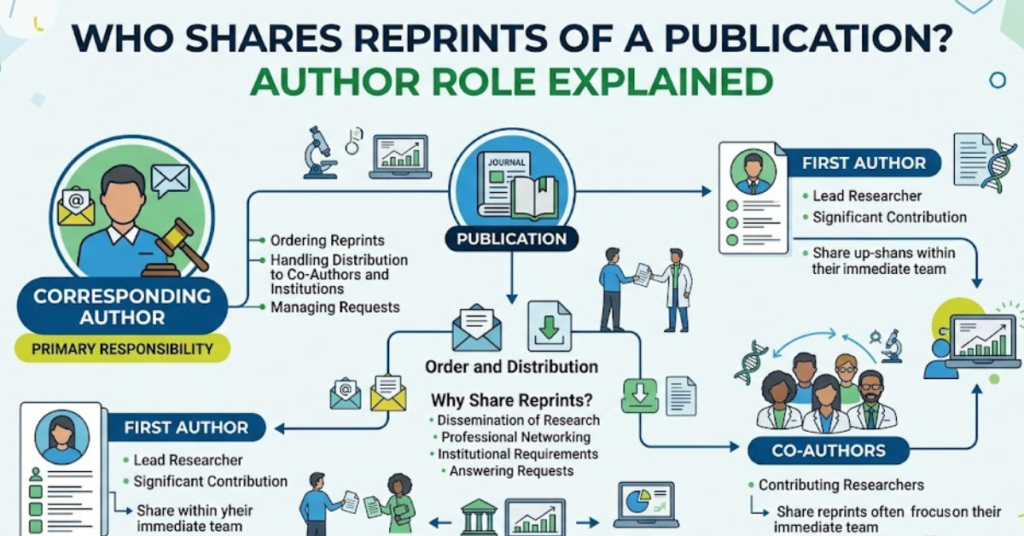
In most academic publishing systems, the corresponding author is normally responsible for sharing reprints of a publication with readers.
Why the Corresponding Author?
The corresponding author is designated to:
- Communicate with the journal during submission and peer review
- Handle revisions and publication queries
- Manage post-publication communication
- Respond to requests for reprints or article copies
Because of this central role, journals typically direct reader requests to them.
Role of Co-Authors in Sharing Reprints
While the corresponding author takes the lead, co-authors may also be involved depending on the situation.
Co-author contributions may include:
- Sharing the publication within their own networks
- Providing copies upon request in informal settings
- Promoting the published work on academic platforms
However, they are usually not the primary contact listed by the journal.
Publisher’s Role in Reprints and Access
It’s important to note that publishers also play a major role in how reprints are distributed today.
Traditional vs Modern Practice
In traditional publishing:
- Authors received physical reprints from publishers
- Corresponding author distributed copies manually
In modern publishing:
- Journals provide DOI links for access
- Open-access articles reduce the need for reprints
- PDF sharing is often governed by copyright rules
So, while authors still get requests, publishers increasingly control distribution through digital access systems.
Digital Age Changes in Reprint Sharing
The internet has significantly changed how scholarly content is shared.
Today, reprint distribution often includes:
- Emailing PDFs (when permitted by copyright)
- Sharing institutional repository links
- Posting preprints on academic platforms (e.g., arXiv, ResearchGate)
- Using journal-provided shareable links
This shift has made the corresponding author’s role more about digital communication rather than physical distribution.
Best Practices for Authors Sharing Reprints
If you’re a corresponding author, here are some good practices:
- Check publisher copyright policies before sharing PDFs
- Prefer sharing official DOI links when possible
- Keep a record of reprint requests
- Use institutional repositories for wider access
- Clarify author sharing rights during submission
FAQs
1. Which author is normally responsible for sharing reprints of a publication with readers?
The corresponding author is typically responsible for handling and sharing reprints with readers.
2. Do co-authors also share reprints?
They can share the work informally, but the official responsibility usually lies with the corresponding author.
3. Are reprints still used in academic publishing?
Yes, but mostly in digital form such as PDFs or journal links rather than printed copies.
4. Can authors freely share published articles?
It depends on the journal’s copyright policy. Some allow sharing, while others restrict it to links or preprints.
5. What is the difference between a reprint and a preprint?
A reprint is the final published version, while a preprint is the early draft shared before peer review.
Conclusion
So, to clearly answer the question which author is normally responsible for sharing reprints of a publication with readers?—it is almost always the corresponding author. They act as the main communication bridge between the journal and the outside world, ensuring that reprint requests are properly handled.
While modern publishing has shifted toward digital sharing and open-access links, the corresponding author still remains the central figure in managing post-publication distribution. Understanding this role helps researchers navigate academic publishing more effectively and responsibly.