
If you’ve ever tried docking a boat in tricky conditions, you already know the stress of watching wind or current slowly push you away from where you need to be. The key question many boaters ask is: how should you approach a dock when the wind or current is pushing you away from the dock?
The answer isn’t about brute force—it’s about control, positioning, and timing. In this guide, we’ll break down practical docking techniques that help you stay in command even when nature is working against you.
Understanding Wind and Current Effects on Docking
Before you even touch the throttle, it’s important to understand what’s happening around you. Wind and current act like invisible hands pushing your boat off course.
How they affect your approach:
- Wind pushes the bow or stern depending on direction and boat profile
- Current moves the entire boat consistently in one direction
- Combined forces can quickly create drift and misalignment
When how should you approach a dock when the wind or current is pushing you away from the dock? becomes a real scenario, the goal is simple: counteract drift without overcorrecting.
Best Docking Strategy in Wind or Current
The most effective method is a controlled, angled approach with gentle power adjustments.
Instead of going straight in:
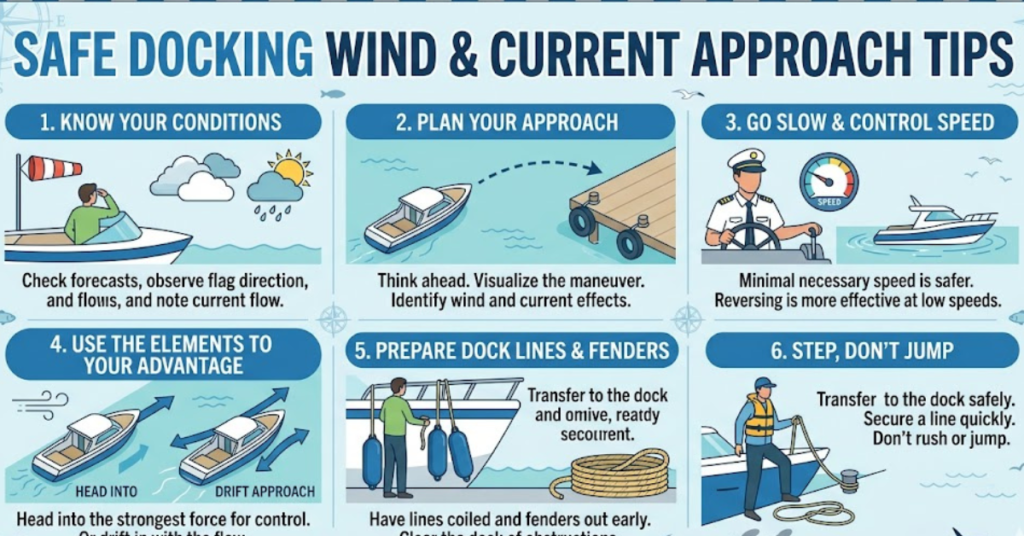
- Approach at a 30–45° angle
- Maintain slow, steady forward motion
- Use short bursts of power for correction
- Keep fenders and lines ready early
This gives you control while still allowing the wind or current to assist (or at least not completely fight) your movement.
Step-by-Step Guide: Docking When Pushed Away
Here’s a simple, practical method you can follow:
1. Assess conditions first
Look at:
- Wind direction
- Current strength
- Available space at the dock
2. Approach slowly at an angle
A shallow angle helps you “slide” into position rather than fighting the water.
3. Use intermittent throttle control
- Small forward bursts to maintain momentum
- Neutral to slow drift
- Avoid constant high throttle
4. Turn the bow into the wind or current
This stabilizes the boat and reduces sideways drift.
5. Shift to neutral early
Let momentum carry you close, then adjust with minimal power.
6. Secure immediately
Once aligned:
- Step off carefully
- Tie bow line first if possible
- Then secure stern line
Common Mistakes to Avoid
Even experienced boaters slip up. Watch out for these errors:
- Overusing throttle (causes loss of control)
- Approaching too fast
- Ignoring wind direction until the last second
- Not preparing fenders and lines early
- Trying to “force” the boat straight in strong current
When dealing with how should you approach a dock when the wind or current is pushing you away from the dock?, patience is your best tool.
Pro Tips for Better Docking Control
Here are a few expert-level techniques:
Use the wind instead of fighting it
Sometimes it’s better to let the wind help angle you into position rather than resisting it completely.
Keep your approach long and slow
A longer approach path gives you more correction time.
Practice “neutral drift control”
Learn how your boat behaves when in neutral—this is key for precision docking.
Always assign roles on board
If you have passengers:
- One handles lines
- One watches clearance
- One communicates with the helm
Safety Considerations While Docking
Docking in wind or current increases risk, so safety should always come first:
- Wear life jackets in rough conditions
- Keep hands and feet clear of dock edges
- Avoid jumping from boat to dock unless necessary
- Use non-slip footwear
- Communicate clearly with crew
A calm, controlled approach is always safer than rushing.
FAQs
1. What is the safest speed for docking in wind?
Slow idle speed is best. You should always prioritize control over momentum.
2. Should you approach the dock against the winds or with it?
It depends on conditions, but generally approaching slightly into the wind or current gives better control.
3. What if the wind is pushing me away from the dock too fast?
Increase your angle of approach and use short bursts of power to maintain position rather than fighting straight in.
4. Do bow thrusters help in windy docking?
Yes, bow thrusters significantly improve lateral control, especially in strong wind or current.
5. What is the biggest mistake beginners make?
Approaching too fast and overcorrecting with throttle instead of using small adjustments.
Conclusion
So, how should you approach a dock when the wind or current is pushing you away from the dock? The answer lies in patience, angle control, and smart throttle use. Instead of fighting the conditions, work with them using a slow, angled approach and precise adjustments.
With practice, docking in wind or current becomes less stressful and more predictable. The key takeaway: stay calm, stay slow, and let control—not force—do the work.