
In geometry, one of the most reliable ways to prove triangles are identical in shape and size is through the SAS congruence rule. If you’ve ever wondered which pair of triangles can be proven congruent by sas?, you’re actually asking about one of the most important triangle congruence theorems used in proofs and exams.
The Side-Angle-Side (SAS) rule helps determine when two triangles are exactly the same without needing to measure every side or angle. In this article, we’ll break down how SAS works, what conditions must be met, and how to quickly identify congruent triangle pairs.
Understanding SAS Congruence Theorem
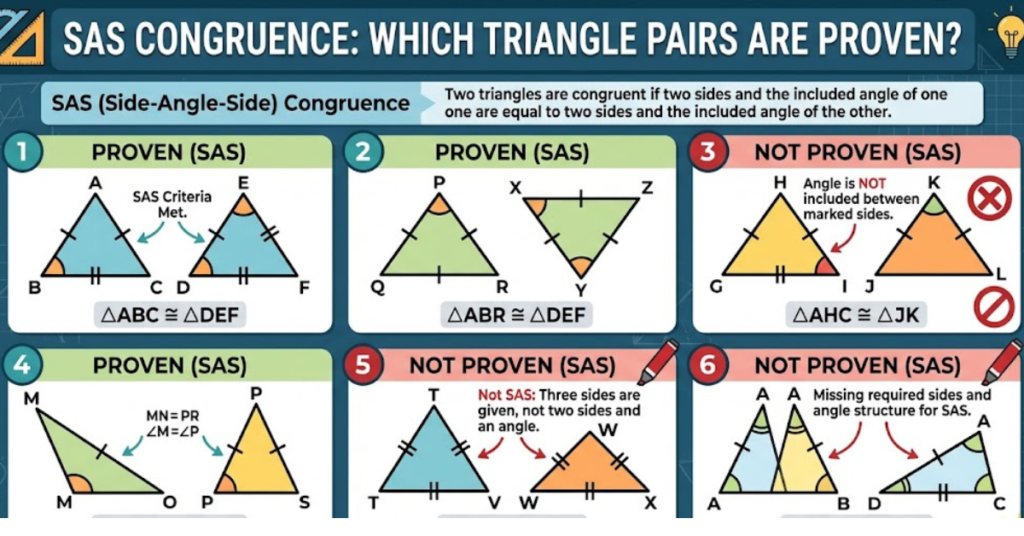
The SAS Side-Angle-Side congruence theorem states that:
If two sides and the included angle of one triangle are equal to two sides and the included angle of another triangle, then the two triangles are congruent.
This means the triangles are identical in every way—even if they are rotated or flipped.
What SAS Means Side-Angle-Side
To apply SAS correctly, you must have:
- Two corresponding sides that are equal
- The included angle (the angle between those two sides)
- Matching measurements in the second triangle
This is one of the most commonly used triangle congruence rules in geometry because it is both simple and powerful.
which pair of triangles can be proven congruent by sas?
To directly answer the question which pair of triangles can be proven congruent by sas?, we look for triangle pairs that satisfy the Side-Angle-Side condition.
Conditions Required for SAS Congruence
Two triangles can be proven congruent by SAS if:
- Two sides in one triangle match two sides in another triangle
- The angle between those two sides is equal in both triangles
- The angle must be included (not adjacent or opposite)
If even one of these conditions is missing, SAS cannot be used.
Example of SAS Triangle Congruence
Let’s break it down with a simple example:
Triangle ABC and Triangle DEF:
- AB = DE
- AC = DF
- ∠A = ∠D (and this is the included angle between the sides)
Since two sides and the included angle match, we can say:
Triangle ABC ≅ Triangle DEF (by SAS)
This is a classic case of which pair of triangles can be proven congruent by sas? in action.
Visualizing SAS in Real Problems
In real geometry problems, SAS often appears in:
- Isosceles triangle proofs
- Coordinate geometry questions
- Construction-based diagrams
- Symmetry problems
Quick Checklist for SAS:
- Two equal sides
- One equal included angle
- Matching triangle structure
If all three are present, congruence is guaranteed.
Common Mistakes in SAS Congruence
Many students confuse SAS with other rules like ASA or SSS. Here are frequent errors:
- Using a non-included angle instead of the included one
- Assuming two angles and a side is SAS (that’s ASA or AAS)
- Matching incorrect sides from different positions
Avoiding these mistakes makes solving geometry proofs much easier.
FAQs
1. What does SAS stand for in triangles?
SAS stands for Side-Angle-Side, a rule used to prove triangle congruence.
2. Which pair of triangles can be proven congruent by sas?
Two triangles that have two equal corresponding sides and the included angle equal between them can be proven congruent by SAS.
3. Is SAS enough to prove triangles congruent?
Yes, SAS is a complete proof rule in Euclidean geometry.
4. What is the included angle in SAS?
It is the angle formed between the two sides being compared in each triangle.
5. Can SAS be used in all triangle types?
Yes, SAS applies to scalene, isosceles, and equilateral triangles as long as the conditions are met.
Conclusion
Understanding which pair of triangles can be proven congruent by sas? comes down to recognizing one key idea: two matching sides with the included angle between them. The SAS congruence rule is one of the most reliable shortcuts in geometry proofs.