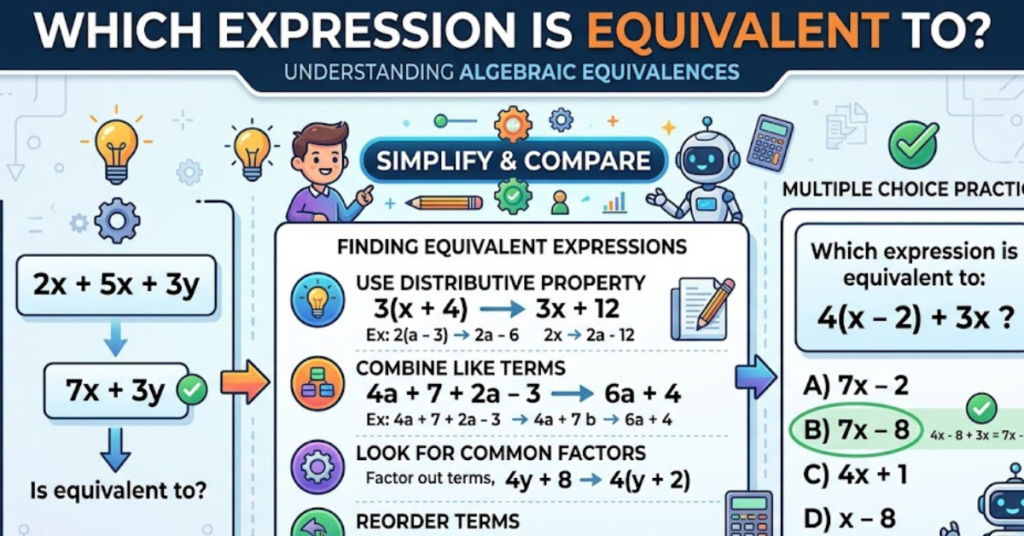

When solving algebra problems, one of the most common questions students ask is: which expression is equivalent to? This concept is at the heart of simplifying equations, solving word problems, and mastering algebraic thinking. Whether you’re working with polynomials, fractions, or linear expressions, understanding equivalent expressions helps you verify answers and solve problems faster.
In this guide, we’ll break down what equivalent expressions are, how to identify them, and practical methods to simplify expressions with confidence.
What Does “Which Expression Is Equivalent To?” Mean?
The phrase which expression is equivalent to? refers to finding two mathematical expressions that may look different but have the same value for all valid inputs.
In simpler terms:
- They may look different on the surface
- But they always produce the same result
Example:
- 2(x+3)2(x + 3)
- 2x+62x + 6
These are equivalent expressions because they simplify to the same form.
Understanding Equivalent Expressions in Algebra
Equivalent expressions are a core topic in algebraic simplification. They often involve:
- Expanding brackets
- Factoring expressions
- Combining like terms
- Applying algebraic identities
Common LSI Keywords:
- algebraic expressions
- simplifying expressions
- mathematical equivalence
- factorization
- distributive property
How to Find Which Expression Is Equivalent To?
To answer which expression is equivalent to, follow these simple steps:
Step 1: Apply the Distributive Property
Multiply terms outside brackets with each term inside.
Example:
3(x+4)=3x+123(x + 4) = 3x + 12
Step 2: Combine Like Terms
Group similar variables and constants.
Example:
5x+2x=7x5x + 2x = 7x
Step 3: Factor When Needed
Rewrite expressions into a simpler multiplied form.
Example:
x2+5x=x(x+5)x^2 + 5x = x(x + 5)
Step 4: Substitute Values Verification Method
Pick numbers to test if both expressions give the same result.
Example:
- Expression A: 2x+42x + 4
- Expression B: 2(x+2)2(x + 2)
Try x=3x = 3: both give 10 → equivalent confirmed.
Common Mistakes Students Make
When solving which expression is equivalent to?, learners often:
- Forget to distribute correctly
- Mix up signs (especially negatives)
- Combine unlike terms
- Skip verification steps
Avoiding these mistakes improves accuracy significantly.
Real-Life Importance of Equivalent Expressions
Understanding equivalent expressions isn’t just classroom theory. It’s used in:
- Engineering calculations
- Computer programming logic
- Financial modeling
- Data analysis and algorithms
Quick Practice Examples
Try identifying equivalent expressions:
- 4(x+2)4(x + 2) → ?
- x+x+xx + x + x → ?
- (x+5)+(x+3)(x + 5) + (x + 3) → ?
Answers:
- 4x+84x + 8
- 3x3x
- 2x+82x + 8
FAQs
1. What does equivalent expression mean in math?
Equivalent expressions are different-looking expressions that have the same value for all values of variables.
2. How do I check if two expressions are equivalent?
Simplify both expressions or substitute values to verify if they produce the same result.
3. Why is finding equivalent expressions important?
It helps simplify problems, solve equations faster, and check correctness in algebra.
4. Is factoring the same as finding equivalent expressions?
Factoring is one method used to rewrite expressions into an equivalent but simpler form.
5. What is the easiest way to solve “which expression is equivalent to?” problems?
Start by simplifying both expressions using distribution, combining like terms, and then verify with substitution.
Conclusion
Understanding which expression is equivalent to is a foundational skill in algebra that makes solving equations much easier and more efficient. By mastering techniques like distribution, factoring, and combining like terms, you can quickly identify equivalent expressions with confidence.