
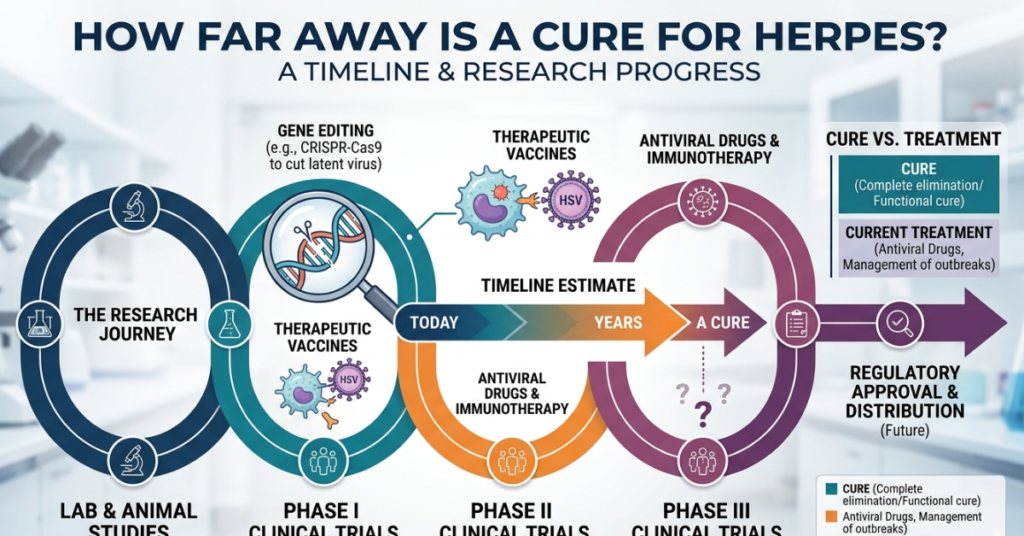

It’s a question millions of people quietly search for: how far away is a cure for herpes? With ongoing research and frequent headlines about breakthroughs, it can feel like a cure might be just around the corner—but the reality is more complex.
Herpes, caused by the Herpes Simplex Virus (HSV-1 and HSV-2), is a lifelong condition because the virus hides in nerve cells. That makes it especially challenging to eliminate completely. Still, science is making steady progress—and there’s reason for cautious optimism.
Why Is Herpes So Hard to Cure?
To understand how far away is a cure for herpes?, you need to know what makes the virus unique.
Key challenge:
- HSV becomes latent, meaning it hides inside nerve cells
- It can reactivate later, causing outbreaks
Unlike many infections, herpes doesn’t stay in one place where medication can easily target it. Instead, it “goes quiet” and avoids detection by the immune system.
Current Treatments: Managing, Not Curing
Right now, there is no complete cure for herpes. But treatments are effective at managing symptoms.
Common antiviral medications:
- Acyclovir
- Valacyclovir
- Famciclovir
What they do:
- Reduce outbreak severity
- Shorten healing time
- Lower transmission risk
So while these treatments don’t eliminate the virus, they make living with it much easier.
How Far Away Is a Cure for Herpes? (Realistic Timeline)
Let’s address the big question again: how far away is a cure for herpes?
The honest answer:
- No confirmed cure exists yet
- Promising research is underway
- A widely available cure is likely years away, not imminent
Scientific progress happens in stages:
- Lab research
- Animal testing
- Human clinical trials
- Regulatory approval
This process can take 10–15 years or more, even for successful treatments.
Promising Research and Future Possibilities
Even though a cure isn’t here yet, several exciting approaches are being explored.
1. Gene Editing (CRISPR Technology)
Researchers are studying ways to:
- Target and remove viral DNA from nerve cells
- Potentially eliminate the virus completely
2. Therapeutic Vaccines
Unlike preventive vaccines, these aim to:
- Reduce outbreaks
- Strengthen immune response
- Possibly suppress the virus long-term
3. Antiviral Innovations
New drugs are being developed to:
- Block viral replication more effectively
- Reduce latency periods
These advancements are why scientists remain hopeful.
What You Might See Online vs Reality
If you’ve browsed forums like how far away is a cure for herpes? reddit, you’ve probably seen mixed opinions.
Important things to keep in mind:
- Online discussions often include speculation
- Not all claims are scientifically verified
- Breakthrough headlines don’t always mean immediate availability
It’s always best to rely on evidence-based medical information rather than rumors or anecdotal stories.
Can Herpes Ever Be Fully Cured?
This is one of the most debated questions in virology.
The possibilities:
- Functional cure: Virus remains but causes no symptoms or transmission
- Sterilizing cure: Virus completely eliminated from the body
Most experts believe a functional cure may come sooner than a complete eradication.
How to Manage Herpes While Waiting for a Cure
While research continues, there are effective ways to manage the condition.
Practical tips:
- Take prescribed antiviral medication
- Maintain a strong immune system
- Manage stress (a common trigger)
- Practice safe physical contact
These steps can significantly reduce outbreaks and improve quality of life.
FAQs About Herpes Cure
1. Is there a cure for herpes right now?
No, there is currently no complete cure, but treatments are effective.
2. How far away is a cure for herpes?
It’s likely still several years away, depending on research progress.
3. Are scientists close to a breakthrough?
There are promising developments, especially in gene editing and vaccines, but nothing finalized yet.
4. Can herpes go away on its own?
No, the virus stays in the body, though symptoms may become less frequent over time.
5. What’s the best treatment available today?
Antiviral medications like acyclovir and valacyclovir are the most effective options.
Final Thoughts: Progress Is Real, But Patience Is Key
So, how far away is a cure for herpes? The honest answer is: we’re not there yet—but we’re closer than we were a decade ago.
With advances in gene editing, vaccines, and antiviral therapies, the future looks promising. Until then, effective treatments allow people to live normal, healthy lives.
If you’re navigating this condition, staying informed and focusing on proven care strategies is the best path forward—while science continues working toward a cure.