
If you’ve ever watched a war movie or heard someone say “it’s about two clicks away,” you might have wondered: how far is a click exactly?
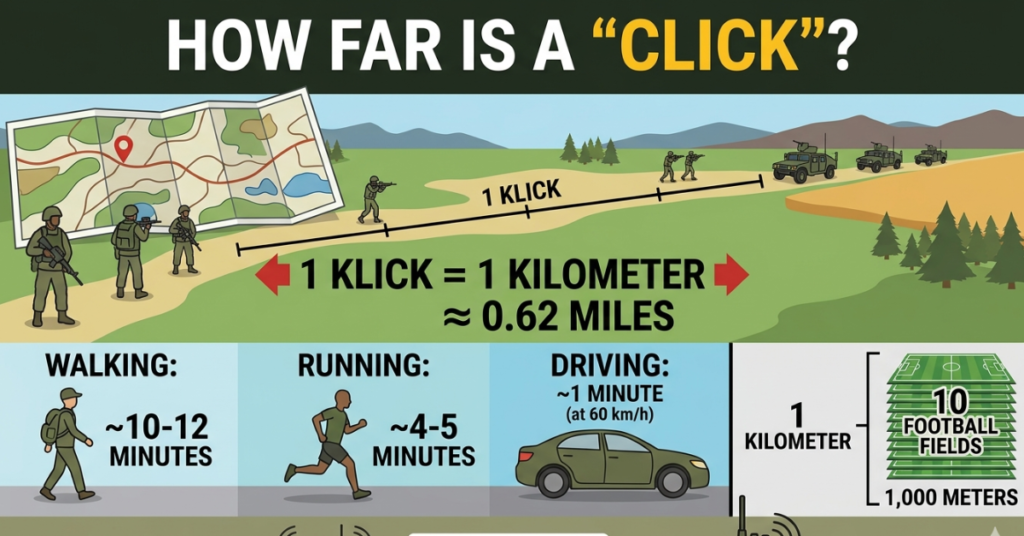
In simple terms, a click (or klick) is military slang for one kilometer. That means when someone says “5 clicks,” they’re talking about 5 kilometers—a precise and standardized unit used in navigation and communication.
Let’s break it down in a way that’s easy to understand, even if you’ve never used military terminology before.
How Far Is a Click in the Military?
In military communication, clarity and speed matter. That’s why soldiers often use short, clear terms like “klick.”
The basic rule:
- 1 click = 1 kilometer
So, how far is a click in the military?
- It’s exactly 1,000 meters
This standard is widely used by forces like the United States Army and other NATO-aligned units.
How Far Is a Click in Miles, Feet, and Yards?
To make it easier to visualize, let’s convert a click into different units.
Distance conversions:
- Miles: ~0.62 miles
- Feet: ~3,281 feet
- Yards: ~1,094 yards
So if you’re asking how far is a click in miles, it’s just over half a mile.
Why Do Military Forces Use “Click”?
You might wonder why not just say “kilometer.” The answer comes down to communication efficiency.
Reasons for using “click”:
- Faster to say in high-pressure situations
- Reduces confusion over radio communication
- Standard across many military units
The term likely evolved from the “clicking” sound of adjusting distance settings on military equipment, though its exact origin is debated.
How Far Is a Click in Army Terms?
If you’re curious how far is it in army terms, the answer remains consistent:
- 1 click = 1 kilometer
Whether it’s infantry, navigation, or map reading, the term doesn’t change. It’s a universal shorthand used in military talk.
How Far Is a Click on a Map?
In navigation, especially with military maps, it helps estimate distance quickly.
On most maps:
- 1 click corresponds to 1 kilometer on the ground
- Map scales help convert distances accurately
For example:
- 3 clicks on a map = 3 km in real distance
This makes route planning faster and more efficient.
How Far Is a Click Away in Real Life?
Let’s make it more relatable.
Real-world examples:
- Walking 1C (1 km): about 10–12 minutes
- Driving 1C: about 1–2 minutes depending on speed
- Running 1C: about 5–7 minutes
So if someone says something is “2 clicks away,” it’s not that far—just a couple of kilometers.
Is a Click Used Outside the Military?
Yes, but mostly informally.
You might hear “click” used in:
- Movies and TV shows
- Video games
- Casual conversations referencing military slang
However, in everyday life, people usually stick to miles or kilometers.
Quick Summary: What Is a Click?
Here’s a simple breakdown:
- 1 click = 1 kilometer
- 0.62 miles
- 3,281 feet
- Used mainly in military communication
Read also <<< “How Hard Is the MCAT“
FAQs About Click Distance
1. How far is it?
A click equals 1 kilometer or about 0.62 miles.
2. How far is it in military terms?
In military usage, a click always means 1 kilometer.
3. How far is it in miles?
Approximately 0.62 miles.
4. How far is it in feet?
Around 3,281 feet.
5. Is “click” used worldwide?
Yes, especially among military forces that use the metric system.
Final Thoughts: A Small Word With a Clear Meaning
So, how far is a click? It’s a simple, practical unit—1 kilometer—used to keep communication quick and precise in the field.
Even though it started as military slang, the term has made its way into pop culture and everyday language. Now that you know what it means, the next time you hear “it’s a few clicks away,” you’ll have a clear idea of the distance.
Curious about more everyday terms with surprising meanings? Keep exploring—you’ll be surprised how much there is to learn.