
If you’ve ever stopped mid-sentence wondering “is timeframe one word”, you’re definitely not alone. This is one of those small but surprisingly common English grammar questions that can trip up even confident writers.
The keyword is timeframe one word often appears in searches because people want a clear, definitive answer before using it in emails, academic writing, or professional content. In this guide, we’ll break it down in a simple, practical way so you’ll never hesitate again.
Let’s clear the confusion once and for all.
Is “Timeframe” One Word or Two?
The short answer: “timeframe” is commonly one word, especially in modern American English.
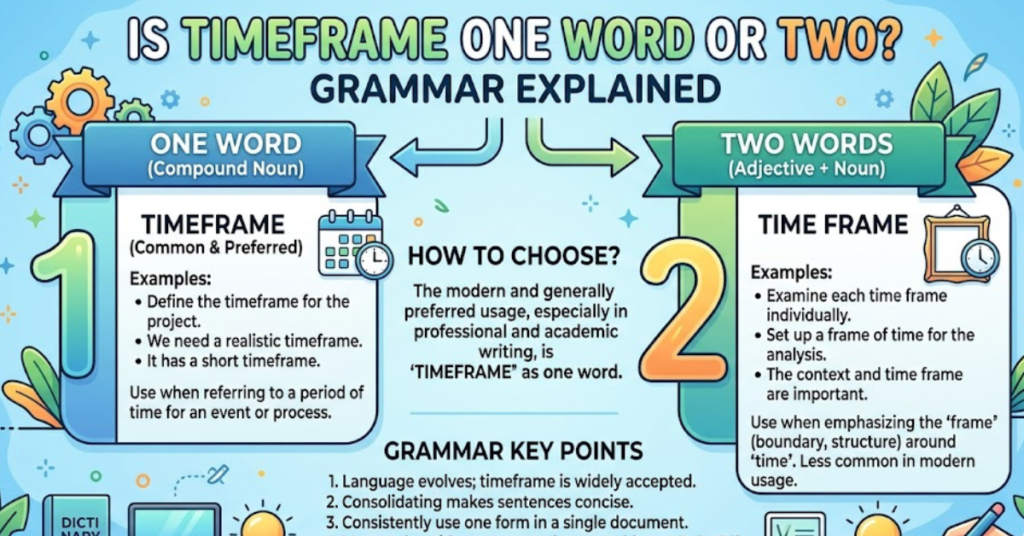
However, “time frame” (two words) is also correct and widely accepted. Both forms are grammatically valid, but usage depends on style guides and context.
Quick breakdown:
- Timeframe (one word): More modern, commonly used in business, journalism, and everyday writing
- Time frame (two words): More traditional, often preferred in formal academic or British English contexts
So, when asking is timeframe one word or 2, the answer is: both are correct, but one-word usage is now more popular.
What Does “Timeframe” Mean?
Before deciding how to spell it, it helps to understand what the word actually means.
A timeframe refers to:
- A specific period in which something happens
- A planned or estimated duration
- A deadline range for completing tasks or events
Examples:
- The project must be completed within a short timeframe.
- We are working with a tight time frame for delivery.
- The hiring timeframe is expected to be two weeks.
In all these cases, the meaning remains the same regardless of spelling.
Why Is “Timeframe” Sometimes One Word and Sometimes Two?
The English language evolves constantly. Many compound words start as two separate words and eventually merge into one over time.
This is exactly what happened with “timeframe”:
- Original usage: “time frame” (two words)
- Modern usage trend: “timeframe” (one word)
- Current reality: Both are accepted, but one word is more common in digital writing
Why the shift happens:
- Faster writing and typing habits
- Influence of business and tech communication
- Simplification in modern English usage
So if you’re wondering is timeframe one word or 2, think of it as a word in transition that has already been widely accepted in its combined form.
Which One Should You Use: “Timeframe” or “Time Frame”?
Choosing between the two depends on your writing context.
Use “timeframe” (one word) when:
- Writing business emails
- Creating web content or blogs
- Working in marketing or tech industries
- Following modern US English style
Use “time frame” (two words) when:
- Writing formal academic papers
- Following strict style guides (like some British English rules)
- Submitting scholarly or legal documents
Simple rule of thumb:
If you’re unsure, “timeframe” is usually safe and widely accepted.
Common Mistakes People Make
Even though this seems simple, there are a few common errors:
- Writing “time-frame” unnecessarily (hyphen is rarely needed today)
- Mixing both forms in the same document
- Assuming one version is “wrong” (both are correct)
Keeping consistency is more important than the choice itself.
Real-World Usage Examples
Here’s how both versions appear naturally:
Business context:
- We need a realistic timeframe for project completion.
Academic context:
- The study was conducted over a six-month time frame.
Everyday use:
- What’s your timeframe for moving to the new house?
Both are perfectly understandable and widely used.
FAQs About “Is Timeframe One Word?”
1. Is timeframe one word or two in British English?
Both are used, but British English often prefers “time frame” (two words).
2. Is “timeframe” grammatically correct?
Yes, “timeframe” is completely correct and widely accepted in modern English.
3. Which is more common: timeframe or time frame?
“Timeframe” (one word) is more common in business and digital writing today.
4. Should I use a hyphen: time-frame?
No, the hyphenated form is outdated and rarely used in modern writing.
5. Does Google prefer one version over the other?
Search engines recognize both, but “timeframe” is more frequently used in online content.
Conclusion
So, is timeframe one word? The answer is yes—but not exclusively. Both “timeframe” and “time frame” are correct, and the choice depends on style, context, and audience.
If you’re writing for modern audiences, especially online, timeframe (one word) is usually the preferred and more natural option. It’s widely accepted, SEO-friendly, and commonly used in professional communication.
The key takeaway? Consistency matters more than perfection. Pick one form, stick with it, and your writing will stay clear and professional.