
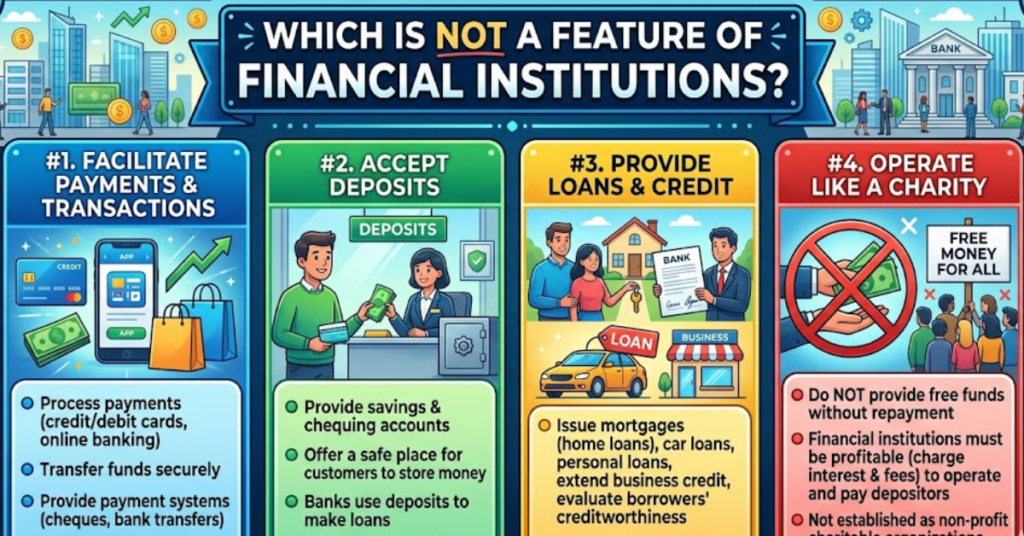

When studying banking and finance, one question often confuses students: which of the following is not a common feature of a financial institution? It sounds simple, but the answer depends on understanding what financial institutions actually do—and what they don’t do.
A financial institution is basically the backbone of any economy. It handles money, credit, savings, and investments. But not every business activity falls under its role. In this article, we’ll break down its core functions, highlight the odd ones out, and help you confidently identify non-features in exams or real-world scenarios.
What Is a Financial Institution?
A financial institution is an organization that deals with monetary transactions and financial services. These institutions act as intermediaries between savers and borrowers.
Common examples include:
- Commercial banks
- Investment banks
- Credit unions
- Insurance companies
- Microfinance institutions
These organizations help keep money flowing smoothly in the economy.
Common Features of Financial Institutions
To understand which of the following is not a common feature of a financial institution, you first need to know what is common.
1. Accepting Deposits
Financial institutions allow individuals and businesses to safely store money in savings or current accounts.
2. Providing Loans and Credit
They lend money for:
- Personal use
- Business expansion
- Housing and education
3. Facilitating Payments
They enable transactions through:
- Cheques
- Debit/credit cards
- Online banking
4. Managing Financial Risk
Insurance companies and banks help manage risks like:
- Loan defaults
- Market fluctuations
- Life and property risks
5. Investment Services
They also help clients grow wealth through:
- Mutual funds
- Bonds
- Stocks
Which of the Following Is NOT a Common Feature of a Financial Institution?
Now to the key question: which of the following is not a common feature of a financial institution?
The correct concept:
Manufacturing physical goods or products is NOT a feature of financial institutions.
Financial institutions do not produce tangible goods like:
- Cars
- Electronics
- Clothing
- Machinery
Instead, they deal with financial services, not physical production.
Why Manufacturing Is NOT a Financial Function
This is where many exam questions try to trick you.
Financial institutions focus on:
- Money flow
- Credit systems
- Investment management
But manufacturing belongs to the industrial or production sector, not finance.
Key differences:
| Financial Institutions | Manufacturing Companies |
| Deal with money | Deal with physical goods |
| Provide loans/services | Produce products |
| Manage investments | Manufacture items |
| Operate in financial markets | Operate in industrial markets |
So, if you see options like:
- Accepting deposits
- Lending money
- Manufacturing goods
The odd one out is clearly manufacturing.
Other Non-Common Features Exam Traps
Sometimes questions are phrased differently. Other incorrect options may include:
- Agricultural farming activities
- Direct retail selling of physical products
- Industrial production of goods
- Non-financial charitable donations as a core function
These are not primary roles of financial institutions.
Real-World Example
A bank like HBL or Bank Alfalah:
- Offers savings accounts
- Provides loans
- Processes digital payments
- Does NOT manufacture products
This makes it easier to identify the correct answer in multiple-choice questions.
FAQs
1. Which of the following is not a common feature of a financial institution?
Manufacturing physical goods is not a common feature of financial institutions.
2. What are the main functions of financial institutions?
They accept deposits, provide loans, facilitate payments, and manage financial risks.
3. Is selling products a financial institution function?
No, selling physical products is not a core function of financial institutions.
4. Why don’t financial institutions manufacture goods?
Because their role is financial intermediation, not industrial production.
5. What sector handles manufacturing instead?
The industrial or manufacturing sector handles production of physical goods.
Conclusion
Understanding which of the following is not a common feature of a financial institution becomes simple once you know the basics: financial institutions deal with money, not physical production.
Anything related to manufacturing, farming, or industrial goods is outside their scope. This distinction is crucial not only for exams but also for building a strong foundation in economics and finance.